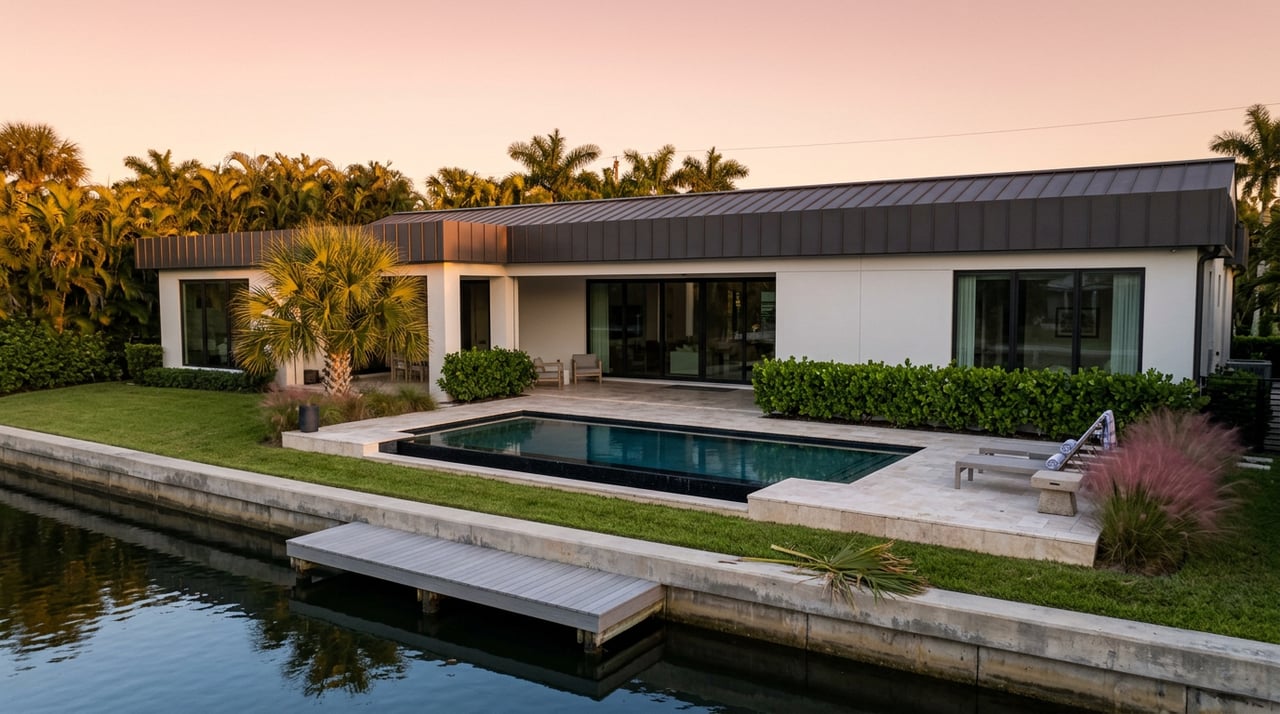
Bradenton's Waterfront Missed Florida's New Permit Break
September 24, 2026
September 24, 2026
Florida homeowners spent the summer reading headlines about a new law that sounded like a gift: skip the building permit on small residential projects, starting July 1, 2026. House Bill 803 passed both chambers unanimously, Governor DeSantis signed it in early May, and by midsummer contractors across the state were fielding calls from homeowners who wanted to know if they could finally swap out cabinets or refinish a lanai without the paperwork.
If you own waterfront property in Bradenton, the honest answer is: probably not, and for two separate reasons written into the same bill.
HB 803 exempts single-family residential work valued under $7,500 from needing a building permit, provided the owner files a written exemption request with the local building department. That much is straightforward. But the statute carves out two categories that apply almost by design to Bradenton's water-adjacent housing stock.
The first carve-out excludes any electrical, plumbing, structural, mechanical, or gas work, regardless of cost. A dock repair, a seawall tieback, a boat lift replacement: all of it counts as structural or marine work, so none of it ever qualifies for the exemption no matter how small the invoice.
The second carve-out excludes any property located in a flood hazard area, full stop. This one catches even the cosmetic jobs the law was written for. A $4,000 interior paint refresh or a cabinet swap that would sail through the exemption process on a dry inland lot in Manatee County still needs a permit if the parcel sits inside a FEMA-mapped flood hazard zone, which is precisely the designation that runs along the canals, bayous, and river frontage that define Bradenton's waterfront market. The city and county both maintain flood zone lookup tools that show AE, VE, and X designations by parcel, and it is worth checking your specific address rather than assuming based on the neighborhood.
Put those two exclusions together and a waterfront homeowner in Bradenton gets almost none of the relief the rest of the state is talking about. The marine structures are excluded by trade classification. The land-side cosmetic work is excluded by location. Both doors are closed at once.
| Project type | Bradenton waterfront parcel | Non-waterfront parcel outside a flood zone |
|---|---|---|
| Interior paint, cabinet swap, flooring under $7,500 | Still needs a permit if the parcel is in a flood hazard area | Exempt with a written request |
| Dock, seawall, or boat lift work of any value | Always needs a permit (structural/marine trade) | Not applicable |
| Electrical, plumbing, or gas work under $7,500 | Still needs a permit | Still needs a permit |
| Fence repair, screen porch repair | Depends on flood zone status of the parcel | Exempt with a written request |
The law also bars splitting a larger job into smaller invoices to duck the $7,500 threshold, which building departments have watched contractors attempt for years under the old rules and will keep watching for under the new ones.
Even setting HB 803 aside, Bradenton waterfront sellers run into a jurisdictional split that catches people who assume their mailing address tells the whole story. Properties inside the city limits pull their building permit from the City of Bradenton's Building and Permitting Division. But a meaningful share of the canal-front stock on the west side, along stretches like Riverview Boulevard and the shoreline around Palma Sola Bay, sits in unincorporated Manatee County and falls instead under the Manatee County Development Services Department. Same mailing address, different building department, different permit history to search.
Add the marine layer on top and the stack gets a third and fourth agency: the Florida Department of Environmental Protection's Southwest District handles the environmental resource permit and submerged lands authorization for anything built over state-owned water bottom, and the Army Corps of Engineers' Jacksonville District reviews the federal side. None of this changed on July 1. HB 803 touches building permits issued by cities and counties. It does not touch FDEP or Army Corps review, which means every seawall, dock, and lift on the water in Bradenton still runs through the same multi-agency process it always has.
The permit exemption is a forward-looking rule. The bigger risk for a waterfront seller in Bradenton is backward-looking: work that was never permitted in the first place, sometimes done by an owner two or three sales ago, sitting quietly in the county's Accela records or the city's permit history until a title search, a lender's underwriter, or an insurance binder turns it up.
Two consequences tend to surface late in a transaction. A lender or title company that finds an open or expired permit, on a roof, a pool enclosure, or a seawall, generally will not fund or insure the deal until it is closed out, which can mean bringing in a marine contractor for a fresh inspection before closing rather than after. And for waterfront parcels specifically, unpermitted additions can trip FEMA's Substantial Improvement Rule, which caps how much improvement value a flood-zone structure can absorb before it triggers elevation requirements. That is not a hypothetical: it is the kind of finding that turns a routine listing prep into a renovation conversation the seller did not plan to have.
None of this shows up on the MLS or in a standard home inspection report. It shows up when someone runs a permit history search, which is exactly why doing it before you list, rather than after an offer, is the difference between a clean 30 to 45 day closing and a scramble in the final week.
A seawall or dock in Bradenton also lives in a splash zone where wood and steel corrode faster than the rest of the structure, and a professional marine inspection before listing tends to catch a cracked cap or a slipping tieback while it is a repair rather than a replacement. Local marine contractors, Anderson Dock & Lift and Mariner Dock & Seawall among them, offer pre-sale inspections specifically for this reason.
Before you put a Bradenton waterfront home on the market, three checks are worth the half day they take:
Run a permit history search through both the City of Bradenton and Manatee County Development Services Department, since a single Bradenton mailing address does not tell you which office holds the record. Order a marine structure inspection on any dock, seawall, or lift, since that work is excluded from the new permit exemption regardless of cost and any deficiency found during a buyer's due diligence period will cost more to fix under deadline pressure. And confirm your parcel's FEMA flood zone designation directly through the county's flood zone tool rather than assuming based on what a neighbor's policy costs, since zone boundaries determine both insurance requirements and which renovations trigger the substantial improvement threshold.
This is the kind of groundwork that pairs naturally with a construction background rather than a purely transactional one. Knowing which permits a seawall repair actually needs, and which agency issues them, changes how a listing gets priced and prepped before it ever goes live.
Does HB 803 help any Bradenton homeowners? Yes, if the parcel sits outside a mapped flood hazard area and the project is cosmetic, non-structural work under $7,500. That describes a meaningful share of inland Manatee County housing. It describes very little of the canal, bayou, and river-adjacent stock that makes up Bradenton's waterfront market.
What if my dock or seawall was built decades ago without a permit? It happens more often than sellers expect, sometimes from work done under a previous owner who never closed out the file. A permit history search through the county or city building department is the way to find it before a buyer's lender does.
Does the flood zone exclusion apply to condos too? HB 803's exemption is written for single-family dwellings, so condo owners were never eligible for the sub-$7,500 exemption in the first place, regardless of flood zone.
Is the written exemption request automatic once I qualify? No. Even for cosmetic work outside a flood zone, the law still requires filing a written request with the local building department before starting, along with documentation of the project's scope and value.
Waterfront property in Bradenton rewards the kind of preparation that starts months before a listing goes live, not the week an offer comes in. If you are weighing a sale on the Manatee River, Palma Sola Bay, or one of the canal communities in between, the Michelle Ward Group can walk your permit history and marine structures with you before a buyer's lender does it for you. Get your instant home valuation to start the conversation.
Stay up to date on the latest real estate trends.
The Michelle Ward Group is constantly building its reputation, which is critical to buyers and sellers of real estate. Michelle Ward Group is a well-experienced team that consistently delivers the results the most affluent home buyers and sellers demand.